
Rodrigo Murgia receives the Industrial Award from the conference committee in recognition of the presentation “Modular Miniaturized GC-MOS Platform: Design, Characterization, and Proof-of-Concept Validation
July 2, 2026
How can bio-based materials become a viable alternative to conventional plastics without compromising durability and performance?
July 29, 2026

We are pleased to announce that the first article from Hadi Saniei’s PhD work within the SERENADE project has been published in the Journal of Cleaner Production, a Q1 journal with an Impact Factor of 10.7.
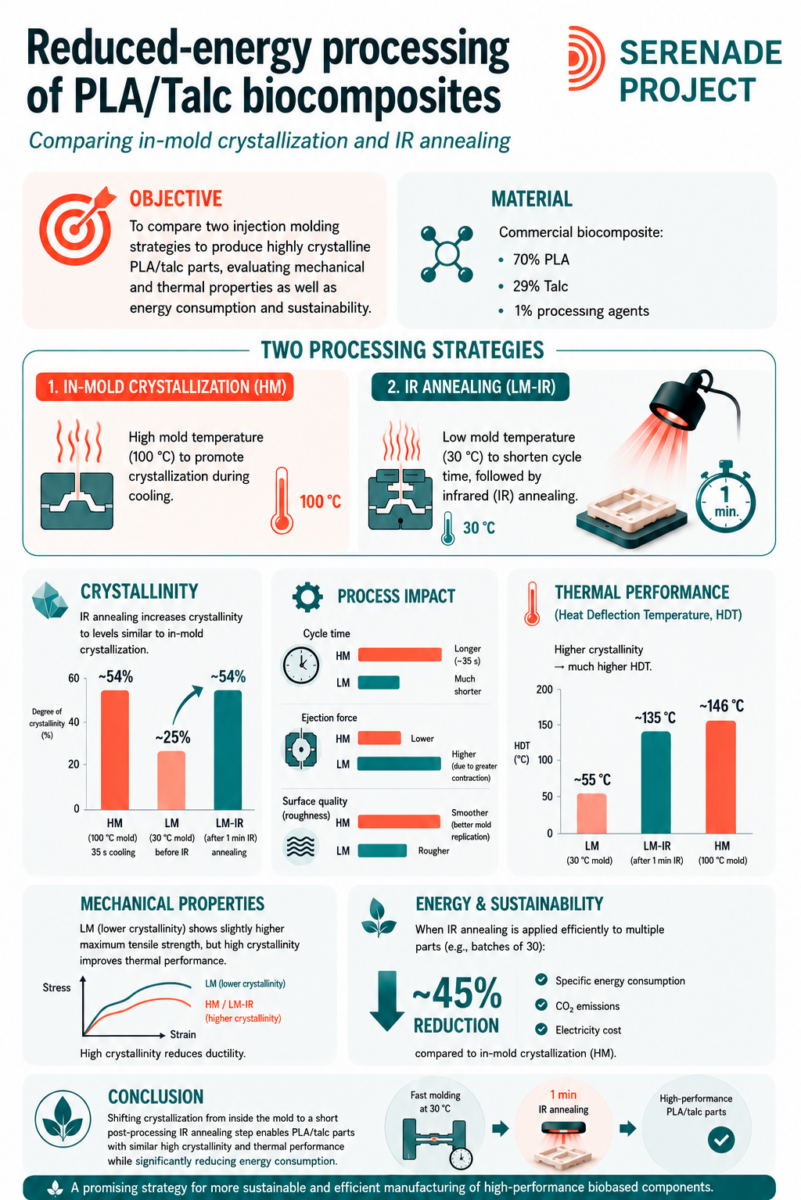
In line with the sustainability-oriented objectives of the SERENADE project, this study investigates two manufacturing strategies for producing highly crystalline PLA/talc biocomposite parts by injection molding, with a focus on crystallinity development, manufacturability, part quality, mechanical and thermomechanical performance, and process energy consumption.
PLA is one of the most promising bioplastics for replacing petroleum-based polymers due to its renewable origin and biodegradability. However, PLA is still mainly used in single-use or short-life products, while its wider application in durable components is limited by its slow crystallization rate during processing and its relatively low thermal resistance. Improving its crystallinity through more sustainable and energy-efficient processing strategies is therefore essential to enhance its durability and expand its use in higher-performance applications.
To address this challenge, the study compares two processing routes:
- High Mold Temperature injection molding: crystallization is promoted directly inside the mold by using a mold temperature above the glass transition temperature of PLA (~60 °C).
- Low Mold Temperature injection molding + Infrared post-molding annealing: parts are first produced at low mold temperature, followed by infrared post-molding annealing to promote crystallization after demolding.
The experiments were carried out using a PLA/talc biocomposite containing a high talc content to promote crystallization. The study evaluated how the two processing strategies affect crystallinity, manufacturability, part quality, mechanical and thermomechanical performance, and energy demand.
The results provide valuable insight into how injection molding at low mold temperature combined with infrared post-molding annealing can be used as an effective strategy to manufacture highly crystalline PLA/talc biocomposite parts with improved thermal durability, supporting applications such as dishwashable food containers. Hadi’s experiments showed that this strategy enabled faster production while reducing energy consumption by approximately 45% compared with the High Mold Temperature injection molding route, suggesting potential benefits in terms of lower CO₂ emissions and processing costs.
These findings contribute to the broader goal of the SERENADE project: developing more sustainable materials and manufacturing routes for high-performance biobased products.
Congratulations to Hadi and all collaborators involved in this work.
Would you like to learn about the study’s results? Click here to read the article by our PhD candidate, Hadi Saniei.